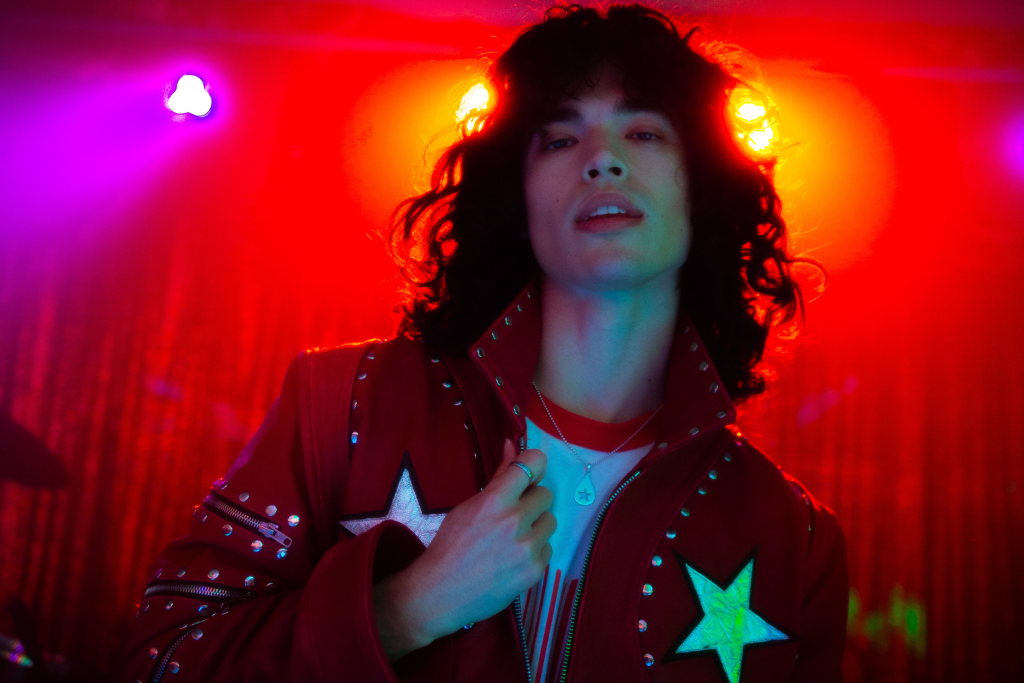
Sly Hats: A Man Under The Influence
Geoff O’Connor steps aside from Crayon Fields for Sly Hats.
“I was always really shy; I could never even join in the ‘Happy Birthday’ singing thing. So I guess [singing, playing in a band] is just that thrill of doing something you’re naturally not comfortable with, and sort of refining it to this point where you can do it in front of people,” Geoff O’Connor , singer/guitarist from Melbourne’s pop heroes the Crayon Fields, murmurs down the phone line. It’s late February 2007 and while things are going full steam ahead with all things Crayon-like, Geoff’s mind is noticeably fixed elsewhere. It’ll be another four months until the fruits of his diverted attentions appear in the form of the solo-esque opus Liquorice Night, the first long player attributed to his Sly Hats moniker.
The first time I saw Sly Hats was early 2005, supporting K recording artist Little Wings at the Kirk (a church-slash-sometimes-venue) in Sydney. Besotted by the awkward shared intimacy between Geoff and his on- and off-stage partner of the time, Jessica Venables (Jessica Says), I’ve been a fan ever since. Shortly after the show I picked up a rough EP which has occupied the “loved and lo-fi” section of my heart since, and have been waiting oh-so-patiently for a follow up.
Fast forward to early June and it’s the day after the first of Liquorice Night’s album launches. The rain is dutifully tumbling on Sydney’s early winter skyline as Geoff plays the good tourist and sups his afternoon coffee at the Art Gallery of NSW’s cafe. After years of allowing musical obsessions to flourish into functional the pre-popstar anxiety still exists.
“That’s when I’m most comfortable,” Geoff responds, when asked about playing to a crowd of unfamiliar faces, as will be the case on the international tour he is currently readying himself for. “I can never play at parties – I’ve played at two and it freaks me out. I hate – if I was singing for three people [gurgles] my stomach would start bubbling.”
What about if those three people were watching, but in a crowd of 100? Surely that would be more inducing of the stomach bubble?
“The amount of people I don’t know or just don’t recognise would balance how embarrassed I would be by playing in front of the three people who knew me. I remember reading about people who say they’re most nervous when the lights are shining on them and they can’t see anyone in front of them and have no idea how people are reacting, and that seems like the most ridiculous thing ever. If I could see how people were reacting, even if they were reacting well, I would be constantly anxious about whether that was suddenly going to change.”
As Geoff continues to tell the tale of only once singing ‘Happy Birthday’ to someone, solo, over the phone for $10 while busking at Melbourne’s Crown Casino, my mind trails off to 2006, when Sly Hats (ie. Geoff, and Geoff alone) played a show in my then kitchen. Hollowed of all adornments excepting oven, sink and fridge, a modest crowd squeezed in as Geoff nervously took to the makeshift stage, rushing through his set with what I had thought to be the twee charm of humility. It’s only now I realise the fear such a small audience would have instilled in him, and feel overcome by regret. I dismiss it for the benefit of finding out more of the evolution of a pop genius, but the courage of someone so openly embracing his biggest fears, regularly, continues to impress.
“It always seems like the most awkward, uncomfortable thing to do,” he proffers plainly. “And I guess that’s what excited me about it. I think I started for that reason. It was like almost overcoming a fear.”
“It’s always going to be the most exciting thing if you’re performing songs in front of people if you’re naturally quite shy. It’s the only opportunity you have to present a really considered – it’s a really considered presentation of yourself, basically. You’ve written these songs. It’s like cheating. It’s like having a nice sort of interesting conversation with someone where you’ve prepared notes, that sort of thing. It’s like being that annoying person in tutorials who goes off on little tangents about things they’re experts on.”
Later that afternoon after art, but again over coffee, we nestle into east Sydney’s Italian strip where conversation leans towards inspiration and aspiration. To the most clichéd of questions (so, Geoff, what’s been one of the more significant inspirations for you making music?) O’Connor provides the most heart-string pulling of responses.
“I think one of the things that made me really want to be proactive in forming bands and making music at a young age would have been in about year eight or year nine, this really shy person in my class – outrageously shy who, when asked a question, would just really scatter an answer, wrote this piece for those horrible end of year magazines that they have at school. There was this short story she wrote and it was brilliant. And it just completely fascinated me that someone who obviously couldn’t articulate the way she thinks about things and her opinions on things in a social environment could make something like that. And I think that’s the most beautiful thing about music and all artforms – this idea that you can be – a lot of people who are socially dominant and that sort of thing can take control of conversations and express themselves, and so much of it’s got to do with self-confidence and that sort of thing. And a lot of people who might be able to contribute but don’t quite have the confidence might fumble around trying to articulate themselves, and then this gives people like that the opportunity to express themselves.”
Do you think all art is about that? A prepared presentation of yourself?
“Not necessarily. I think often people are trying to, sort of, [hesitates] I guess often people like to – aren’t very comfortable with how crafted and prepared a lot of it is, in terms of music, that’s why they often like to have improvised lyrics. Now I’m going off on a tangent.”
Tangents aside, Geoff’s philosophy of music making and person presenting consciously compliment each other. What I like best about Liquorice Night is that presentation of person, and the way that Geoff’s persona interacts with all the sounds – be they sourced from guests or instruments – to embellish what Sly Hats is, and what Geoff wants to be.
“That’s sort of the purpose. That’s the main thing I’m interested in in terms of production. I like having the central two things which is the basic chord structure, the melody, lyrics and that sort of thing in one, at the forefront, and then everything else is creating this backdrop.”
Listen to Liquorice Night and you’ll hear a backdrop realised in as much meticulous detail as the lyrical and guitar-based focus points of the record. Drafted as a project that could exist as acoustic guitar and vocals alone, Sly Hats has evolved to accommodate more and more. Even the simplest of songs involves the intricacies enabled in production (“I might add three guitar tracks to make one guitar track sound nice,” Geoff tells me guiltily). Much like its familial predecessor, The Crayon Fields’ Animal Bells of last year, it was recorded in O’Connor’s bedroom and awarded the time to allow that realisation.
“I suppose the Crayon Fields songs, the songs are very old – songs that were written in my very formative years, and the same goes for all the early Sly Hats recordings. The reason none of them ended up really being on the album was because that was a process of learning how to record songs and create the type of sonic textures that I wanted, and get used to this really cohesive sonic ecology, and that sort of crap. I’m not particularly interested in production, in terms of learning about it and that sort of thing,” Geoff ends, bluntly.
The hours spent transferring the sounds in his head to sounds on tape might suggest otherwise, but for Geoff the recording process is more about the sounds, than the technicality behind creating those sounds. “It’s more I just want to be able to control that,” he declares.
Having finessed versions of songs right up until mastering it seems the process of learning about sounds is constantly developing. Three of Liquorice Night’s songs were penned in the week before mastering, and the album’s release date was pushed back and back in order for Geoff to have that level of control. Still, it’s not enough. Geoff – the perfectionist behind the perfect pop – suggests an endlessly-altered version of the album available for download, weekly, to ensure that listeners always had the version he was happiest with. That’s the level of control we’re talking about here…
“Melodically a lot of the songs are derived from songs I was trying to write a while ago but I had no idea how to structure a whole progression around that – I still have very little knowledge of music theory and that sort of thing - I never used to have the means to actually create the sounds that I wanted, back then.”
So the whole process of a home-built and bred studio is a way of mastering music making as a form of communication, and allowing the self a canvas to unfold upon. If I were being overtly tacky I’d say something like, “finding the language for effective communication” but instead I’ll settle for finding the tones to touch on emotion. Shit, that’s just as tacky…
“You don’t really know how a song’s going to make you feel until you actually hear it not coming straight from your mouth. You can sing a song to yourself on the guitar and feel good about it and then you listen to it as the other person listening to you, you’re removed from it, and it becomes more difficult to make sense of it. And so if you’re recording it yourself you can work with that, you can use that as a draft,” Geoff says.
“One of the reasons I’d be uncomfortable recording with someone else is that I would play a song, have it half finished, and that’s the only way that that person’s heard that song. And it would make less sense to anyone, anyone recording, that I would want to scrap that and start again, because they haven’t written the song and thought about how it would be arranged, that’s all they have to go on, that initial version. And I just always find people who talk about how disappointed they are with the recording they did and they wish that at some certain point they had scrapped something, but they committed too much to it, whereas if you’re recording yourself you’re not committing anything to it except for your own spare time.”
“I could have watched an entire season of Dawson’s Creek. I feel like I’ve really missed out,” he throws in with a wily sarcasm.
“I generally carry a notepad around with me and try and jot down ideas, then have a little meeting with myself trying to figure out what on earth this song’s about and why.”
Months earlier Geoff had told me how he fills every empty minute thinking about songs: “I just develop [the ideas] and try as hard as I can not to make it obvious that I generally carry a notepad around with me and try and jot down ideas, then have a little meeting with myself trying to figure out what on earth this song’s about and why. It’s nice because you’ve always got something to ponder and think about, you’re never going to be bored. Even if you find yourself standing up on a tram with no walkman and you’re looking at the back of someone’s really grey cardigan, or something, you can just try and think of how you’re going to add to a song.”
It’s only now that this idea seems fully recognisable in my mind, that by having the opportunity to work on writing and recording with an equal limitlessness you can tailor the presentation of yourself in finite detail, and that becomes enough to concern your every waking moment.
In 25 years when the Liquorice Night redux silver anniversary edition hits the stands, complete with the 90-plus versions it took to get to the album’s final 111 cuts, will Geoff’s obsessive sonic ecology be appreciated? This record’s screaming for an extended reissue.
“I think the other thing in terms of sounds, the thing I often want to get out of sounds primarily is something that’s evocative, in terms of a presence. The percussion – I like the way that evokes images of a mass of people, and I like backing vocals, even ‘oohs’ and ‘aahs’, which are not really – there’s no lyrical content to them, but I like having this song that behind it this backdrop of people singing.”
When Geoff’s reverb-drenched vocals caress your ears, it’s not just the words that ask for your tissue whisper to soak his fears. You want to comply, of course, but the romancing is as much to do with the chorus of harmonising instruments and percussive persuasion as what his lyrics yield. Liquorice Night is an incredibly intimate record that makes you feel just a tiny bit invasive with every listen. Is the romance real?
“I’m perpetually single so I’ve got to write as romantic lyrics as possible to allure people.”
To make everyone swoon?
“And then when that happens I’ll start writing lyrics about breaking up and the like.”
But they sound like they’re really intimate in some situations, are they actual happenings?
“No they’re not. I like writing about situations where there’s romantic potential. Or like really awkward situations that you have with people.”
“I try and – I basically try and exaggerate and try and sort of… I guess I just like to imagine things as a romantic encounter.” Yes, the hopeless romantic and hapless romancer once more prevails as the perfect ingredient for songwriting success. I dread the day this changes for selfish reasons – if happiness in love is going to change the way Sly Hats songs come out then I want smiles to stay well away from Geoff. Not really. But kind of…
Outside of O’Connor’s own endearing persona, musical or otherwise, it is very much the interaction of his chosen sounds that give Liquorice Night its endlessly listenable quality. The contribution of the female players in his parade of stars and, in a broader sense, the quality of the sounds that make the cut, give the record a richness in character so often lacking in contemporary pop offerings. As Fabulous Diamonds’ Nisa Venerosa questions Geoff on the album’s opening and title track my limbs go weak. The calypso rhythms and their understated execution in ‘Windy Harmony’ have the opposite effect, making a slight sway define those same limbs. Later on in the listen Birth Glow and ex-Jemima Jemima frontwoman Ellen Carey again poses points for self-reflection to the musical O’Connor in idiosyncratic echoing ecstasy with “will you allow this?” and the audience waits, eagerly, for Geoff’s response. The call-and-response technique is nowhere near new in pop music, but Sly Hats borrows from an alternate artistic tradition – crafting a cinematic screen of sounds within which his characters unfold, and the character of each song alongside it.
“I compose things,” Geoff starts to explain. “The way I sort of add extra arrangements, it’s to fill certain gaps – little holes that are left in as a result of the shambolic production. There might be nothing sitting in this certain frequency range so I’ll add something there.”
“I like it to all sound very much performed. I like when you can hear that someone’s been playing. Like on those keyboard parts sometimes I would mic up where the fingers were touching the keys, so that you could hear the clunks. And that sort of added to it for me. One of the things I like about this guy Martin Denny – he’s this crazy composer from the ’60s, I think, my friend lent it to me – he’s got all these animal sounds in the background, and when my friend told me about it I thought this was going to be the most irritating, horrible thing, but they’re really spooky animal noises and they create this extra presence that adds to the songs. And some of them are just these boring instrumentals, but some of them are really beautiful, sung by choirs, and I guess you immediately start to picture them being sung in a jungle, or singing in a large hall that’s got this aviary.”
He likens the process to something like the album’s title track: “The first version had no percussion at all and it sounded very much like I was playing the song alone, whereas on the re-recording there’s this wall of percussion behind it that sounds like I’m singing it amidst a busy cafe.”
But it’s not merely a process of filling in the gaps: “Songs that I didn’t feel were great without the extra layers I didn’t want to bother to refine them into being just average. I’m not really into trying to sell these things if they’re not working out initially. If a song’s not writing itself, if it’s not inspiring harmonies and that sort of thing initially, it’s never going to work.”
The way Geoff describes it does sound like a fair portion is left to chance, but in reality that couldn’t be further from the truth. The sounds that slip through the cracks – that clunking of keys and the sly, crooked melodies that make the cut – are all intentional. In a cyclical synergy it comes back to presenting the self; it seems that anything else would be cheating.
“For instance, having a jam with someone – I love spending time with people and I love people and I like playing the guitar, but the idea of having this freakout noise jam with someone, or performing that even, I’d feel like – it’s another case of removing yourself from the end result. I’d feel like I was just hiding behind the impression that people, that it’s improvised and there were no sort of real attempts to convey something specific,” he admits.
“I guess because I put a lot of effort into writing the songs and that sort of thing there’s a lot of care put into that, I feel like if they [the audience] hate it I’m not really ripping them off. It’s not like I’m cheating them. It’s not like I’m just putting together something solely for the sake of being looked at and listened to for a few moments, they just don’t like it”
This isn’t the first time Geoff’s distaste for improvised music and free-form foundations slides into conversation, but it’s not out of a lack of respect or for failings given to the form – it’s more an issue of aesthetics. Why go free form when you can find the form that best articulates what you’re trying to say?
It seems I’ve almost gotten to the end of this article and said very little about the protagonist of our tale. Geoff O’Connor – early 20s, student, and, like most musicians, part-time telemarketer. In his last semester of a cinema/ English/gender studies-based arts degree, Geoff’s weighing up options as to what area to take into the honours stage of his degree. At the moment his interest lies in cinema, and specifically the work of Maya Deren.
“I’m interested in her theoretical writing, because a lot of it I don’t like,” Geoff smiles. “I like the idea of writing about someone I don’t entirely agree with.”
Deren’s ideas centred on the obstacles Hollywood poses on cinema as an artform through its artistic, political and economic monopoly over the form. Geoff attempts to explain the intricacies to me, but I get lost somewhere amid “non-narrative” and form and pick up again when the non-specific artform discussion resumes. Things that are actively anti-narrative have a narrative too – by actively working against something they’re buying into that tradition, I suggest.
“Exactly. That’s true. I just think that idea of trying to work in opposition against anything is a bit silly. What are you trying to communicate by doing that?”
He brings the idea back to music: “It’s a similar sort of thing – I’ve never liked that argument that a lot of people have that, you know, if you’re writing songs you’re not moving forward musically. You’re supposed to stretch the boundaries…” and with these words I throw the concept of guilty pleasures out the window. What does that mean anyway? To suggest that songs realised with structure, form and finesse are any less artistically legitimate than a drawn out exploration of sonic boundaries is to be bound by preconception more tightly than the most devoted pop practitioner.
Again flowing with the film analogy Geoff draws upon director John Cassavetes as a point of reference. When asked what he hopes people draw from his music, both as Sly Hats and from his role in the Crayon Fields, it takes a while for any formed sentences to emerge.
Read any review and they’re sure to mention the word “twee”, but I’m certain O’Connor, the songwriter, carries the weight of the term unfairly. Sure, a handclap here and there does maketh the twee, but on Liquorice Night I’d say his songwriting shares more with the richly crafted balladeering that accompanied velvet walls in adorning late-’60s lounges around the world. As a friend put it, he’s something of Melbourne’s answer to Serge Gainsbourg, but without the sleaze. In short, I’d suggest there’s more than the invisible yet arbitrary one-inch button labelled “twee” that gets pinned on O’Connor that links his two musical manifestations.
“I guess I hope people see it as someone trying to express themselves in a very concise, direct manner. And someone who’s trying to use the medium of music to embellish,” he decides.
“In contrast to what I’ve said about – oh I guess it doesn’t contradict what I’ve said about improvisation – I am very curious about the ways in which that [improvisation] could be used, like in terms of a performance I saw the other night where this guy managed to conduct a group of people in a room, most of them barely knew each other, to make sounds just with their mouths and that sort of thing. He would use his hands to sort of indicate what sounds they were supposed to make, and he would use that to control the dynamic of the performance and that sort of thing. That’s certainly something I would like to draw upon a bit. I’ve always liked the idea that you can manipulate people into creating something; that while you have a certain element of control over it, to try and sort of spark this other – this end result that is exciting rather than simply spontaneous for the sake of being spontaneous.”
“One of the filmmakers I love the most is John Cassavetes and I’ve always loved the fact that a lot of people thought that his first film, Shadows, was an improvised film. I guess a lot of that is because of the way it was marketed, apparently – I wasn’t there – but really he was one of the most manipulative filmmakers out there, and everything was so tightly scripted. While he would get people to be drunk in their performances and in their takes, and they could do 10 or 15 takes and tell them that they – give them little direction in what they could do – ultimately that was a way in which he was controlling the thing, even more so than someone who was directing someone specifically, because he was just waiting for them to do something that he wanted.”
It’s fitting Cassavetes denotes the end of our conversing. While Sly Hats is a solo project, O’Connor has a steady group of contributors floating around the sounds that emit from his bedroom, their inclusions are interpretations of the blueprint O’Connor presents to them, much like Cassavetes’ own productions. On Liquorice Night, O’Connor’s found the quality of these contributors, and developed a space for them to embellish and enunciate what’s been scripted so far. With his directorial debut in the bag, who knows where the follow up showpiece will source inspiration from? More to the point, who else can’t wait to find out?
+