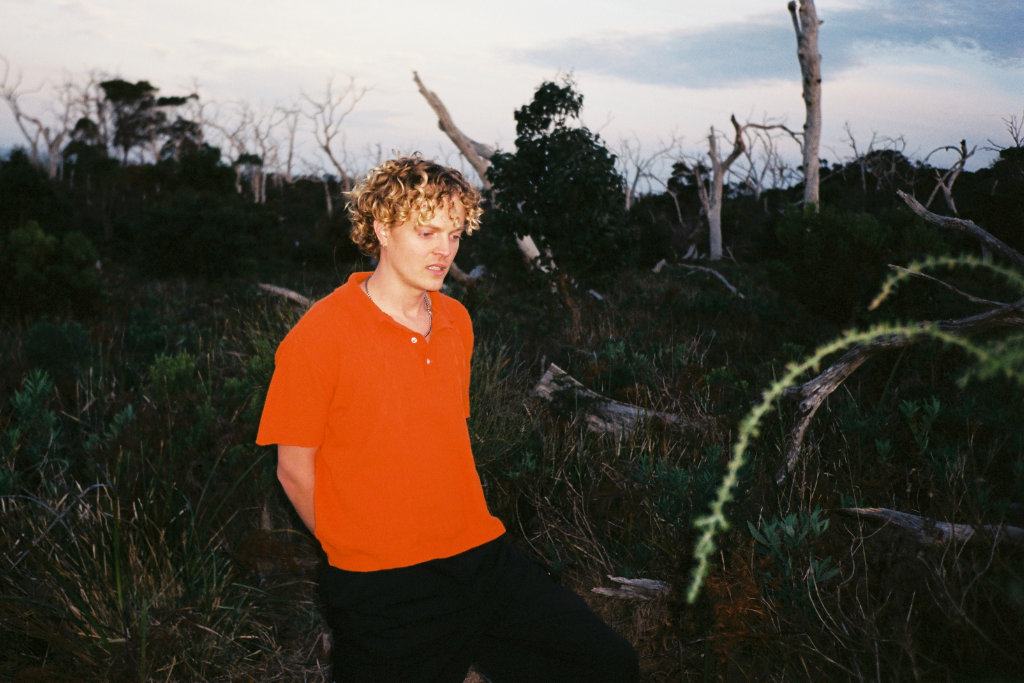
Architecture in Helsinki; Familiar Faces, Worn Out Places
Architecture in Helsinki go around the world in 80 ways on their new album.
Jet lag doesn’t appear to be holding Cameron Bird back, especially once he gets his first hit of caffeine. It’s an overcast July day in Melbourne and Architecture in Helsinki’s unofficial frontman is sitting outside a CBD café, trying to trace his recent movements. Two days prior he flew in from New York, the long haul across the continental United States and Pacific Ocean that took him from his new home, a one bedroom apartment in Brooklyn, to his old one in Melbourne. For the three months prior to that he was pretty much perpetually on tour: North America, Europe and, briefly, Australia.
“It was a pretty easy transition, although culturally it’s a very different place to Australia,” Bird says of his new neighbourhood. “In New York you have to speak like an American to get anything done. If you’re calling for a cab or sorting something over the phone, invariably you have to speak with an American accent. Mine’s okay, but I’m scared I’ll do it here. Most people in New York just assume I’m from the South, because most Americans don’t have a perspective of their own country, let alone outside its borders.”
Architecture in Helsinki’s ramshackle beginnings, when it appeared that there were more people on stage than in the audience, are long gone. They have moved on – literally. Aside from Bird in Brooklyn, Sam Perry is based in Brazil, where his girlfriend lives, and Kellie Sutherland has been living an itinerant existence on the West Coast of America, most recently fetching up in a basement room in the San Francisco house of good friends. The other half of the band – James Cecil, Gus Franklin and Jamie Mildren – still reside in Melbourne.
“When we assemble it’s like putting Voltron together,” explains Bird. He’s wearing a puffy white jacket covered in small, bright circles of colour. It looks like the kind of attire someone in a Tokyo breakdancing crew might have favoured in 1988, but Bird pulls it off with the kind of nerdy enthusiasm that’s become his calling card. He’s voluble, smart and quick on the uptake. When you’re talking he’ll quietly say “yes, yes” to both indicate his comprehension and move you along.
Their sound has changed just as much as their postcodes. Released this week, Places Like This, the group’s third album, is markedly different from both 2003’s Fingers Crossed and 2005’s In Case We Die. Recorded by engineer Chris Coady (“a rad dude,” offers Sutherland) at Brooklyn’s Stay Gold Studios (preserve of TV on the Radio’s Dave Sitek) at the close of 2006, the disc was laid down at the end of an American tour, a situation where circumstances matched expectations.
“The last record was James and I working on it, with everyone else having a lot going on in their lives with jobs and everything. So the two of us went on the dole and were obsessed with making it. This one I wanted to be a band record,” explains Bird. “Touring a lot changes the way you play and we wanted to capture that and to be spontaneous and direct.”
“We hit it off massively [with Chris Coady] and recorded the bulk of the album in 10 days,” Cecil recalls. “It was a new thing for us to record so quickly, but it was the first time that we’d had someone else engineer for us. I recorded the last two albums at our [Supermelodyworld] studio, but this meant we could really concentrate on the playing and the production.”
“The whole experience was totally free. In the past everything was this weird hobby that we laboured over – it was like making a model ship in a bottle that you would touch up every weekend,” adds Bird.
“Cameron’s lyrics are always somewhat ambiguous,” observes Sutherland. “I honestly think that he doesn’t know the best answer himself, nor does he question it. It comes out in his work and he leaves it at that.”
As well as a change from informal home recordings at a converted garage to scheduled sessions with the whole band present, the tone of Places Like This betrays a band determined to move on. The songs are rhythm-based and matched to massed vocals that subvert pop practice and textures that can be either tribal or post-indie. It’s electric in feel and intention, placing it on another plane to the clichéd then and outdated now belief that Architecture in Helsinki are twee indie kids.
“As far as the listening habits of the touring band go we pretty much listen to world music and hip-hop – we don’t listen to rock because we grew up with it. But now we’re leaning towards a rhythm-orientated approach, which just opens up a whole new world of music,” says Cecil.
“Rock is just so boring,” exclaims Sutherland, referencing the album’s international roots.
“We’re big music dorks and everyone is open to listening to anything. If someone says they want to listen to Steely Dan we won’t hold it against them, but if someone brings in a record of a dude playing the thumb piano that they bought at the Camberwell market we’re likely to get obsessed over that,” notes Bird. “We’re conscious of not being complacent with what we listen to.”
The attraction to rhythm was also fostered by the size and regularity of their gigs. “At a lot of our early shows we’d play support to bands and we’d come on and be so quiet. We’d play to 2,000 people and people would just talk over you. Subconsciously we got fed up with that and just started playing louder and louder,” continues Bird.
Architecture in Helsinki now come on like twisted new romantics (‘Same Old Innocence’), folk electronica merchants (‘Underwater’) and Jamaican sunshine popsters (‘Debbie’). Cecil isn’t kidding when he says that they’re currently focused on getting people to dance.
“The theme for this album is that we didn’t want to do anything that we’d done before,” Sutherland says. “If you’re a singer-songwriter I can totally understand how whatever you do comes out like that, but if you’re a band you should expect giant changes. If it doesn’t you should pack it in.”
“There were definitely times when we battled about how something should be done. But overall everyone has a love of things that are intimately massive,” admits Bird. “Something can have a tribal rhythm on percussion, but you can couple that with a love of prog. It can be emotionally intimate, but the scope can be colossal.”
The definitive example remains the album’s first single, ‘Heart It Races’, where the vocal chants are cloaked by spooky textures that offset the celebratory mood. If it feels like a mash-up – of cultures, of centuries, of intentions – it’s because it’s meant to, although hopefully in the exact opposite way that someone like Moby would go about it.
“That song puts all the influences on the record into one piece,” Bird explains. “Things like Alan Lomax’s field recordings were what I listened to most while making the record – that kind of folk music that predates commercial pop music. It’s music at its purest because it’s people in the field or gutting fish and writing songs about that day to day experience. We don’t try to mine cultures. I really want to make sure that we don’t go that way. We want to reference those things, but not be pretentious or overt about it.”
At the same time they were willing to manipulate technology. While Cecil played drums in the studio, the end result deliberately sounds compressed because all the “air” was digitally edited out of the beats. They were kept cramped with the aim of sounding like an early hip-hop record, particularly Critical Beatdown, the 1988 debut by Kool Keith’s first outfit, Ultramagnetic MCs.
The distance between the band’s members also applied during the writing process. Bird relocated to Brooklyn before writing began for the new disc – something that initially alarmed some of his bandmates – and often he would put together the shell of a song and send out the basic demo by e-mail to the rest of the group, who would in turn listen and experiment before offering their ideas in response. Instead of trying to jam together in a room, something they admit to failing at, Architecture in Helsinki accumulated elements at a distance as the demos grew in scope and sound.
One of the most forthright new songs is ‘Hold Music’, which began when Bird brought a Latin drum machine on eBay – cowbells, shakers and percussion, but no bass drum or standard 4/4 means of delivery – and spent an hour every morning writing beats for an entire month. He could knock up more than 20 in that time each day and would cull the best few for further work. Sitting in the lounge of his apartment, which he’d turned into a home studio, Bird added a bassline and acoustic guitar to one idea he favoured and sent it to Cecil.
Using Audio Chat on IM, the pair worked on the beat together. When Kellie Sutherland heard what they’d done she had the idea that the song’s chorus, not out of place on a contemporary R&B record, needed the insistence of a pop diva: “Give it to me, baby, give it to me!”
“I came up with that home and my housemates were out and I had it in my head, so I decided to do it,” remembers Sutherland. “I was cracking up the whole time, but I went over to James’ house and he and Gus were egging me on. At first I thought it was a complete joke, but now I realise it suits that song. The song was ready for that.”
Opposite her Bird’s vocal is demonstrative, even garish. Like David Byrne before him, he casts himself in extremes to observe everyday America, singing about “my friend Lisa” who’s come down to L.A. “to rent a display home”. The concept of hold music is one of his preferred dual meanings – to hold someone or be on hold.
“As is always the case with lyrics there’s always a stream of consciousness involved – there’s no rationale that I’m trying to get across,” he notes. “I’ll sing the melody over and over again until it turns into words. More often than not I’ll be able to interpret those words as meaning something in my life or the life of someone I know. I remember reading an article once where Elton John said that if you didn’t have the song written within ten minutes then it’s not going to work and I kinda like that. If a song can’t instantly grab your attention then it probably won’t work for anyone else.”
“Cameron’s lyrics are always somewhat ambiguous,” observes Sutherland. “I honestly think that he doesn’t know the best answer himself, nor does he question it. It comes out in his work and he leaves it at that.”
Both are delighted with the level of collaboration on the new disc, attributing it to the space between the band members. “It really works,” declares Bird. “It’s been great because we spend a lot of time together touring, but as a collaborative and creative group this is the best the band has ever worked. People would contribute ideas by e-mail or over the phone and they were taken at face value. Ego was removed from the creative process. This time people could spend as long as they wanted on something and then share it and everyone would listen and digest them, as opposed to being in a room where everyone decided straight away.”
The emphasis on collaboration come in the wake of the band’s shrinkage from an eight- to six-piece in the middle of last year, when Isobel Knowles and Tara Shackell left the fold (“creative differences” noted the announcement on the band’s MySpace page at the time).
“No-one really knows what happened,” observes Bird. ”We were all really good friends – and still are – but it was hard. Sometimes you have to pull the band-aid off. The band was a five-piece, and then an eight-piece to replicate the recorded sound, but that ran its course. We could have kept doing that or tried something new. Whether you’re a two-piece or 20-piece, the chemistry is what makes a band work. It was a point where people had moved in different directions.”
“It’s six creative voices being heard rather than eight trying to be heard. It feels like more of a band,” Sutherland says. “There’s one conversation now, rather than three. We’re all there together rather than a few people dropping in. Recording In Case We Die was like a revolving door of band members visiting Cameron and James.”
For Bird change needs to be a constant. As well as getting louder and more rhythmic, the extended touring has made both he and Sutherland more expressive stage performers. On their brief East Coast run of dates in Australia in May some audience members were divided over how the pair threw themselves into the performance.
“I’ve always been a really big fan of vocalists who have a sense of character. I’m not into theatre or musicals, but I appreciate that sense of someone being someone else on stage,” claims Bird. “We try to be ourselves and be honest, but we’re into having a sense of character and drama.”
For Sutherland the motivation is simpler: “I do it purely as some kind of protection. I don’t like to think about those people looking at me. You emulate the personalities in the songs, but it all comes from me though.”
Either way, it’s working. Architecture in Helsinki are an international touring band, increasingly more popular overseas than in their homeland. On their last European tour, with Places Like This finished but not released, Bird and Sutherland did 21 press interviews over two days just in Germany. “Very thorough the Germans,” sighs Bird at the memory.
Still, it’s a small price to pay and the band has stayed true to the ethos that motivated Bird and Cecil seven years ago when they started working together. “We’ve never had a huge amount of financial backing,” declares Bird. “It’s satisfying for us because we’ve beaten ourselves with the touring stick and gone prematurely grey, but the band is growing without us shoving it down people’s throats.”
+