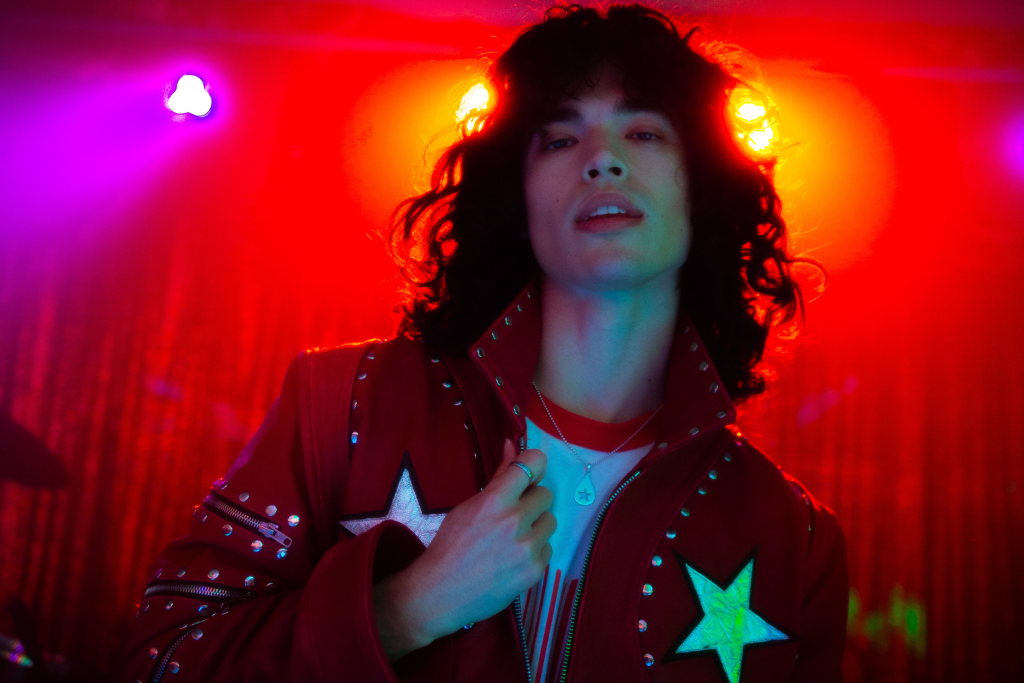
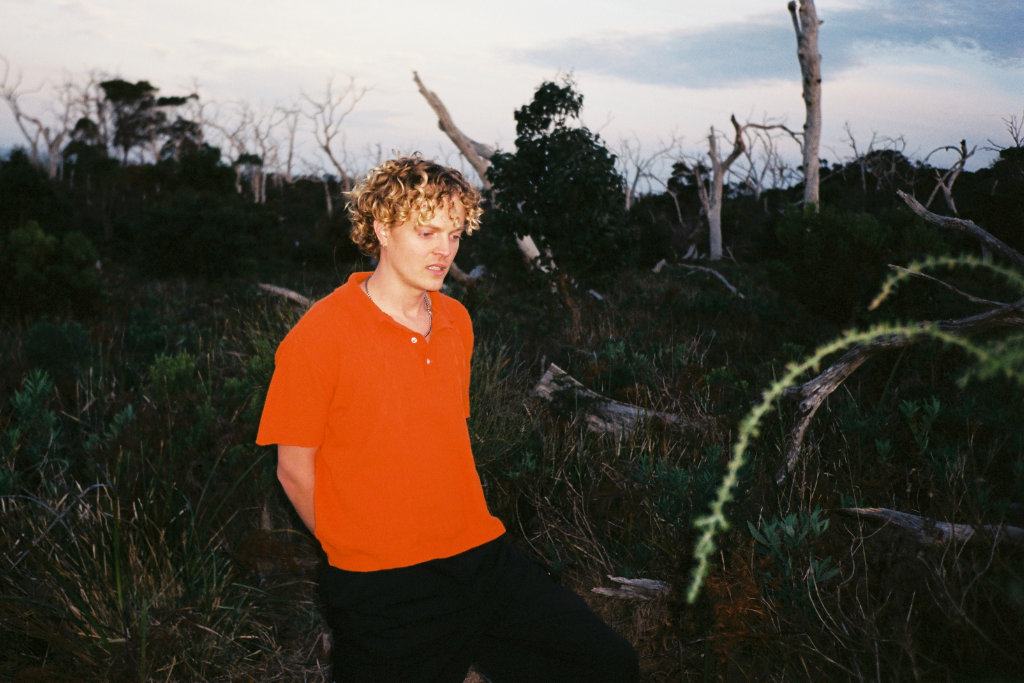
Eleventh He Reaches London
The Young Need Discipline
Perth’s Eleventh He Reaches London: too soft for the hardcore crowd, too hard for the indie kids
It’s noon and I’m at my kitchen bench when the phone rings. Calling is Ian Lenton, singer/guitarist for Perth five-piece Eleventh He Reaches London.
“Hey, man, we’ll be about 20 minutes,” he says. Lenton and drummer Mark Donaldson are supposed to be at my house by now. “We’re just at the bottle shop. You want us to get you anything?”
The unseasonable Perth sun outside and the prospect of talking for a couple of hours make me say yes. “A Tooheys New?” I reply.
“What? Western Bitter?”
Western Bitter is a particularly cheap, gross WA brew. He’s fucking with me.
“Tooheys New,” I repeat. “Tooheys. New.”
“Western Bitter? How many longnecks?”
“Just get here.”
“Okay, man. Western Bitter.”
Twenty minutes later, Lenton arrives with Donaldson and some longnecks for them, two New stubbies for me, two burgers for himself and a gigantic smile on his face. It reminds me of one of the more memorable – and decipherable – lines on ‘What Would Don Juan Say?’ the middle cut on Eleventh He Reaches London’s debut, seven-track LP, The Good Fight for Harmony.
Here’s a tale about a boy / Who’s six foot four and far from a man
Of all the interpretations available to the listener, the one most apt while speaking to Lenton and Donaldson is that, despite their age, they still act like boys. Sometimes these 24-year-olds exhibit the conviction and articulation of men, but, more strikingly, and just as often, they revert to the irreverence of teenagers.
“Scotch College was fucking hard,” notes Lenton, who having dispatched his burgers is speaking of his and Donaldson’s high school over my kitchen table. “You were either a sports hero, or an intellect, or you just coasted through. And it’s safe to say we just coasted through.”
Seated beside him, Donaldson agrees. “We just went against everything by a) not studying ever, and b) instead of playing soccer we’d go poke turtles with sticks,” he says.
“And watch dragonflies have sex,” Lenton gleefully adds. “Remember that? Ever seen dragonflies having sex? You’ve gotta see it. They move in dragonfly motion.”
“It’s all fucking horizontal,” Donaldson says, and the pair crack up.
The way they’re laughing, it’s like they’re on the oval, 50 metres away from the sports heroes, seeing insect coitus for the first time. One constant throughout our discussion is that whatever we’re talking about, they can always instinctively make each other laugh.
When the conversation moves to their music, the dialogue isn’t always as free flowing. They don’t exactly clam up but their faces become serious, they cross their arms and they stare at the table. The words don’t come as easily and will often divert to a funny story. They’re like the boyfriend who can’t talk about his feelings, has to crack a joke when the subject gets heavy. But once the laughter dies down and the hand gestures simulating insect procreation are done with, austerity creeps back in. The dragonfly anecdote, for example, emerges from an explanation of the lines in ‘Say You See Why So’ that goes:
Private school boys / We never gave a shit about anyone else
“I think it was important to have that lyric in there because otherwise on some level it would’ve seemed like we were trying to hide it,” Donaldson explains. “It’s just about being honest. Yeah, we went to private schools. We don’t want to be in a band and pretending we never went to Scotch College.”
That mix of personal bemusement and self-incrimination is just another part of the complex, self-aware muddle that is Eleventh He Reach London. They’re a confessional metal/hardcore hybrid and if that sounds Byzantine, you should actually meet them.
Two weeks earlier we’re at Fibber McGees in Leederville, and Lenton and Donaldson are telling me their history. It’s here that I’m introduced to their chemistry, a mixture of eye-to-eye agreement on music and an easy insistence on making fun of each other. Discussions of their early place in Perth’s hardcore scene, for example, become recollections of inter-band soccer competitions.
“There were huge tournaments, especially outside HQ,” Donaldson says.
“Remember that time I scored three goals?” Lenton says.
“Yes, that was quite amazing,” Donaldson concedes.
“Then you tackled me down the woodchip bank,” Lenton adds.
“Yeah, why did I do that?” Donaldson wonders.
“I dunno, jealous?” suggests Lenton
“Didn’t you have your shirt off?” asks Donaldson, delivering the final riposte.
When Eleventh – whose other members are bassist Craig McElhenny and guitarists Jeremy Martin and Jayden Worts – made their big splash on Perth’s small scene, they introduced a lot of people to a kind of music they’d perhaps heard of but never witnessed up close. It was at the launch for the Sabretooth Tigers’ Never Give Up EP in early 2004. Five guys stood with their backs to an audience more used to the dancey noise of Snowman or the pure pop of the Bank Holidays, and slowly they built up a curious post-rock intro into a tempest of scorched triple guitar, belted double kick drum and a snarled, screamed and bellowed voice.
At the time the histrionics and multitudinous lyrics (an example: Cut it out, cut it out / Creating fictitious fantasies deemed as the right of passage by our father figures / Who bought too highly into reflections of the young adult) were so overwhelmingly dramatic that they verged on the comical. But this show was the beginning of a kind of gigging campaign in the non-hardcore music scene that would eventually win Eleventh a place in the hearts of Perth’s local music mainstream.
“People started to see our music as the whole thing rather than the parts – it wasn’t just, ‘That riff’s sick’,” Lenton recalls. “They started looking at the landscape of the whole song which was kind of what we wanted, hence our songs being so long. We don’t want you to listen to a 10-minute song and appreciate two riffs out of it. Kids in the ‘independent’ scene were seeing that more because they had no footnotes or relationship to the kind of music we listen to.
“That made us feel like we were wanted somewhere else because someone had seen us, and paid attention to us,” he says, “who wasn’t involved in [the hardcore] scene.”
That was a milieu in which Eleventh, for all their emotional bluster, could not thrive. The band formed in high school playing a version of metalcore inspired by Vision of Disorder and Zao (“Jayden got us into them because he was a massive God child and tricked us into liking God music,” Lenton says) that developed over years of songwriting in private and eventually yielded four songs the band was happy with. Not seeing any likeminded bands in Perth they were loathe to play live, but they eventually made their performance debut supporting Melbourne hardcore band Identity Theft, a position gained on the strength of an early track on a local punk compilation.
“Dion [Waterman, from now-defunct Perth punk band Boredumb] heard us on the compilation and rang me up,” Lenton says, putting on a manic voice. “‘Oh my God you guys are sick where did you come from it’s like Eighteen Visions.’ He was the only person who booked us for the first 20 shows.”
But the reason behind their long period of rehearsal – their skepticism about fitting into the Perth music scene – turned out to be accurate. They gigged for almost two years without gaining their own following.
“At first [people] saw us out of fascination because we were a little bit different from everyone else,” Lenton says. “But then you could kind of tell that after a while we weren’t what they wanted to hear.”
Donaldson is quick to put the kibosh on the perception that they moved on to indie audiences after conquering hardcore. “Oh no, let me tell you something,” he says. “We were like the pussies of the hardcore scene, but the opposite of pussies in the indie scene. To me [playing hardcore gigs] was more about getting drunk in a carpark and playing soccer outside the venues than the music. They were welcoming on a friendship level – we made some awesome, awesome friends, and still love seeing those guys – but we just didn’t belong there, we were too different. Which is totally fair. The songs were too melodic and …”
“Long,” interjects Lenton. “Our songs were too long, these kids had grown up on three- minute-or-less songs. And the problem for us was that we thought that scene was the most relevant to us, so that was the only place we could play. We were kind of hoping the audience would be a bit more open-minded than they were. Not to say that hardcore kids weren’t open-minded, they just went to hardcore shows to see hardcore bands. We couldn’t provide that.”
The audiences that opened up to Eleventh after the Sabretooth Tigers show and, following that, Snowman’s Zombies on the Airwaves of Paris launch, greeted the band with a mixture of love and hate, a far cry from the ambivalence of the punks. Those that hated them found it difficult to explore music outside of chorus-verse-chorus structures and backing harmonies, but those that loved found in Eleventh a monolithic approach to song structure that challenged Perth’s normally staid, traditional music taste.
The Good Fight for Harmony is ostensibly the thing one would expect from a band operating inside the insular realm of, apologies in advance, emo. It features songs about Lenton’s broken relationships, his angst and despair. But the self-loathing is not a symptom of unchecked depression. Back at my house, the air smelling of burgers and beer, he says that this is the result of honesty and a critical eye.
“One thing that shits me when I read lyrics is lyricists painting themselves as the complete victim,” Lenton says. “That circumstances were completely unfair, blah blah blah. They did everything right. Nothing shits me more than that because that is just unrealistic. You may as well be singing about galactic ships.”
This belief is reflected in well-observed, self-reflexive lines like, Go on, blame her / Is that all you had to argue / Her failure to see you as that fuckwit we all know. This is the captivating part of Eleventh – the lyrical gymnastics of the songs. ‘What Would Don Juan Say?’ opens with an apology for Lenton’s psychological bloodletting, which is quickly followed by a chastisement for the apology: Oh shit, misdirection on a tangent, played out, I know.
On the epic closing number, ‘Long Grows the List of the Live and Dead Pretenders’, after several lines of referring to a ‘he’, he suddenly switches to ‘I’, afterwards singing, Did I drop the third person act to show how real I can be? I’ve never been real in my life.
But the true potency of the lyrics lay in their ability to match the scale of the music. Eleventh songs don’t follow the hypnotic riff repetition that comparable acts like Isis and Neurosis use so well. Instead, each song contains several disparate, seldom recycled movements, lasting sometimes a minute, sometimes several. Even without the theme-variation-return-to-theme formula, the songs maintain a melodic and rhythmic logic whose climaxes are all the more orgasmic for their unpredictability. The lyrics ramble in kind, resulting in mountainous volumes of words resembling Conor Oberst’s essays. The best of both worlds is had – metal given shape by keenly articulated confession and boyish brooding given balls by shred.
But it’s not all sadsacks and broken hearts. The songs contain an intoxicating obsession with masculinity and place that vaults the album into the mythic – ‘Long Grows the List…’ especially. Here, Lenton’s sense of family obligation is turned up to 11 as he recites his uncle’s dying wishes, to be buried within earshot of the Fremantle town bells and to be dug up, If they sing stockade songs along the dock. In a highlight of the live show he screams, face torn in anguish, I’ll dig you up myself.
Surprisingly, this vivid passage is one of the times some members of the band voiced an objection to Lenton’s lyrics. “[The argument was] that it was too specific,” Donaldson says, “and people who don’t come from Fremantle, which is 99.999% of the world, might read the lyrics of the song then come to the end and say, ‘This doesn’t mean shit to me’.”
“I can completely understand why that could’ve been a stupid decision, but I don’t regret it,” Lenton notes. “Writing those lyrics, everything on the whole record was about me so I came to the end of it and thought, ‘This is so specific and this is what I want to say.’ Everything else in that song is related to Fremantle. It’s a blue-collar song about where I work [the Railway Hotel, the only pub in WA with a license to open at 6am], where my uncle worked, where he died, in Fremantle, and he actually said he wanted to be buried within earshot of the Fremantle bells.”
Eleventh live is a powerful advertisement. The band, a collection of gregarious, good-natured friends, becomes entirely sullen, at times enraged, when performing. “When we started I thought I’d be a humorous character but it’s different up there,” Lenton concedes. “You are performing. That’s what I thought would be ideal, in between music you’d entertain the crowd with witty banter, but I’m never in the mood.”
“I’d love to be comfortable because I think it’d make for a better performance. There’s something about being exposed that hasn’t ever really sat that well with me,” he says. “I think I will eventually, but not at the moment. It’s not really the singing, it’s the thought that if you go watch a band you will usually concentrate on the vocalist. I’m pretty skeptical a lot of the time so that gets in my head: what if there’s a dude out there like me who thinks my fucking hair should be parted on the other side?”
+