View the Mobile Version of M+N

Featured Articles

Skinny Jean: Narrative And Diagnosis

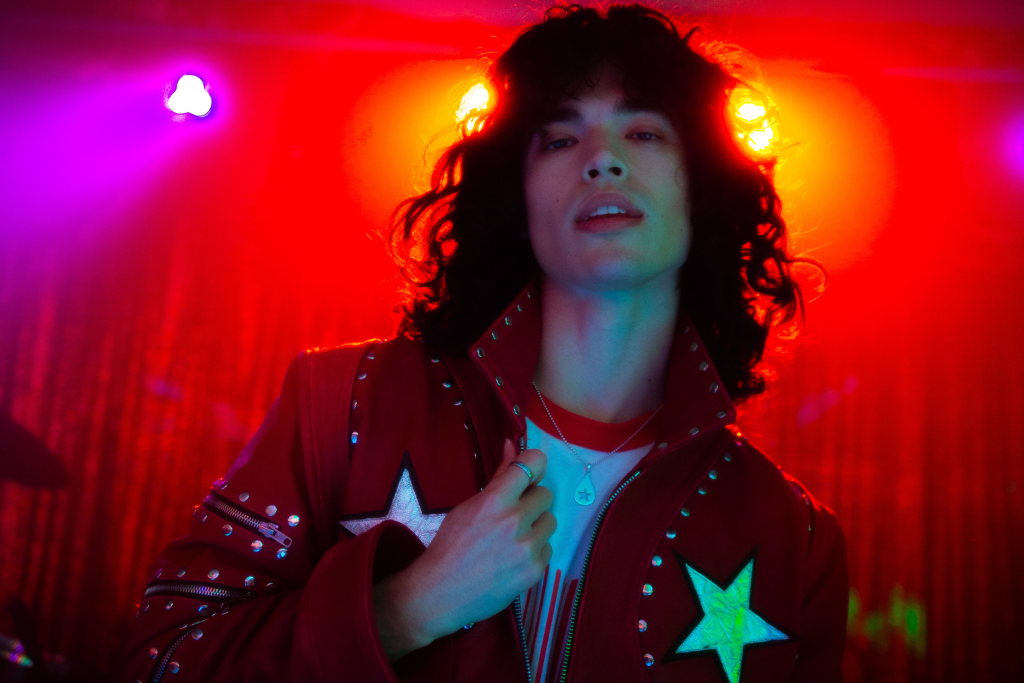
Shem Allen from Brisbane’s Skinny Jean talks to CRAIG MATHIESON about writing from the heart not the head, literary inspirations and being unfairly typecast as a Christian band.

Brisbane five-piece Skinny Jean cover significant terrain on their debut album Dolce Doggerel, including cotton field spiritual, freak folk, ’90s alternative rock, electronic soundscapes and stratospheric pop. It may explain why the record has been released twice: first as an independent project in their hometown and more recently on a national level with the backing of a distributor.

The record is busy to the point of distraction. Named for the opening number on Powderfinger’s 1996 album Double Allergic, the band – Shem Allen (vocals/guitar), Andrew Sydes (guitar/vocals), Jemma Hicks (keyboards/vocals), Graham Ritchie (bass) and Sam Schlenker (drums) – remakes itself from track to track. But it’s not mere restlessness, instead there’s a sense of trying to evolve, of a desire to push themselves as a means of earning their opportunity. Responsibility matters with Skinny Jean.

At the comparatively young age of 22, Allen has more than a few responsibilities himself. Married, for all of four weeks (Skinny Jean didn’t play the reception despite his coaxing), with a nine-month-old baby, he’s trying to finish a small ensemble arrangement for the jazz standard ‘Honeysuckle Rose’ before talking to M+N and then heading off to band rehearsal. The assignment is part of his Bachelor of Music degree from the Queensland University of Technology.

Allen grew up in Toowoomba, the inland city 150 kilometres to the west of Brisbane. It was there that he first met his future bandmates Sydes and Schlenker, with whom he’d jam on blues classics. In Brisbane they went through several bassists before Ritchie joined in 2007, while the following year Hicks replaced Heidi Minchin to cement the current line-up. With Dolce Doggerel already ageing they intend to have a new EP out in May.

The nominal frontman, and chief lyricist, in a committed democracy, Allen is a curious mix of ambition and non-committal observations; occasionally his answers drift away because he doesn’t want to give voice to where they’re leading. On the band’s MySpace page, he credits himself as Skên Onion, partly to see if journalists will use that name without checking and partially as a reminder that his great-grandmother, a member of the Stolen Generation, had Onion forced upon her as a surname.

Silliness and historic tragedy sit together within Allen’s ploy, and such contrasts are a recurring event within and around Skinny Jean.

How does what you’re studying inform what the band’s doing?
It’s quicker to throw an arrangement together, or a vocal part, than if we were untrained so to speak. For me, when I write, I like to use the skills I have to pull things apart and that tries to be more thoughtful in what I write than I used to be. There’s a visceral and cerebral dichotomy that you have to keep a balance between.

The classic rap on studying music is that it over-intellectualises, so that technique and analysis replace feel and inspiration.
The stuff on Dolce is feeling-based – there’s no analytical edge to it because it’s older material. These days the stuff I write is more technical, but if it’s too technical I tend to scrap it.

Are the two streams merging into one?
I hope so. That’s what I want it to become. [Film composer] Bernard Hermann was someone who could create this incredible feeling, but it was also very technical. If something is too technical I think that’s a reflection of immaturity on the composer’s behalf. For me, I want to get to the stage where I can marry cause and effect to a state where you can’t distinguish.

What are your memories of Toowoomba?
Sometimes Toowoomba feels like a country town and sometimes it feels like a big city. It can be pretty, but generally pretty bleak and suburban. Some places in Toowoomba are kinda magical – like the tops of the [grain] silos.

Is that something you’d climb as a teenager?
Yes. Those and the cemetery, which was between my house and the silos, were the key features. We’d climb them at night. But Toowoomba was not conducive to pursuing a career in music, so I moved to the big smoke.

Were you always going to be a musician?
Yes. I’ve been playing guitar since I was two or three, and I’m basically shit at everything else. I wrote a song at 11 – lots of power chords, but I can’t remember the lyrics.

When did you first write what you considered a decent song?
I’m still wondering about that. I wrote [Dolce Doggerel’s] ‘Anhedonia’ when I was 16 or 17. I sat on it for a while, as I did with most things I wrote at that age.

It’s a good small town song.
At the time I was really depressed over high school. I was in the midst of teen angst.

When did you think that there was something to pursue with Skinny Jean?
When we got a triple j Unearthed feature spot [in late 2006] with a very early recording of ‘Anhedonia’ – they liked it and gave us the slot, at which point we went, “Oh, we could do something”. Up until then it had been for kicks.

Did you feel part of a scene in Brisbane?
A little bit divorced. We were just doing what most young bands do – MySpace messaging other bands and asking them if we could play a show together. We were all pretty naive, even Sam who’d played in a touring band previously. We didn’t know how to do anything. The best thing was having mates whose bands were a big further along, plus a lot of friends to come to the shows.

Did you create your own scene or join an existing one?
We merged the two. I’m pretty sure we feel a part of what we do now and I’m pretty sure we brought in other people to join it.

Did you feel a connection to Brisbane’s musical history?
That’s an echelon that’s so beyond everything we know. Even with Regurgitator and Powderfinger it’s like they exist on this other platform – we’ve never supported anyone who has even supported them.

“There’s a fear on our part as being construed as a Christian band, as several members of the band attend church regularly. When you’ve got that connection there, in our experience, it’s so easy to be written off.”

The album is very ambitious, and it sounds like the ambition that comes from having a group of people working together who have very different ideas; no-one worries about how the outcome will be perceived because they’re just interested in whether the ideas can fit together.
Everyone in the band certainly has a creative flair. Everyone is hands on with writing, arranging and producing. It can lead to conflict, it can lead to too many ideas, but it can also lead to some really interesting results where we screw as much out of the songs as possibly can. There’s definitely an ambition on Dolce.

You can hear it in the unexpected changes, the way parts drop in and take over, that signify someone’s idea gaining the ascendancy within the piece. ‘Army Wife’ taking off mid-song is a good example of that.
On ‘Army Wife’ Andrew came up with that guitar line, that belting climax, and I felt that was appropriate. I’d wanted something like that there when I wrote the song, but he exceeded my expectations.

Do you think of the bass and drums as being a rock rhythm section?
Well, jmag said we had too much jazz drumming. A fair proportion of it is 4/4, although our future is less about it. I just get bored with that. As good as so much music is, I feel personally that there’s so much more you can do than stick to 4/4. I want to try and advance that.

You’re embarrassed saying that, aren’t you?
Kind of. Yes.

But many musicians think that: it’s not like everyone starts a band with the aim of maintaining the status quo.
You’d be surprised though. We see a lot of bands where I don’t know how they couldn’t be thinking that, but thankfully they’re outweighed by the ones who aren’t.

A lot of ideas in the songs are dramatic in that they reach for a transcendent moment. It’s not just cathartic, because musically that denotes a brute force, but an attempt to attain a quality beyond that.
When I write songs, and I’m only speaking for myself in this regard, I ask myself, “Is this worth saying and what is the best way of saying it?” More so these days than with the songs on Dolce, which are more lighthearted, when you ask yourself what’s worth saying you think about what you can say and there’s a whole bunch of philosophical questions stemming from that. But the best way to say it musically is with a real drama that hammers the point home, and it feels good to do that live because you can connect with the audience and revivify the song as part of your performance.

Do you get a physical sensation when it works at a gig?
It’s kind of euphoric when something connects with the audience, but also anxiety-inducing as well. It drives you on, but that can lead to over playing it. We’ve had reviews where people have said I lay it on way too thick.

So there’s an addiction to those moments.
Exactly.

You open the album with ‘Good Morning’, a traditional African-American spiritual that’s virtually a century old. Was that a tribute to another time and place or an attempt to capture that emotion for contemporary use?
It’s a mixture of both. I was in this back alley bookshop in Toowoomba and found this book called American Negro Songs [by Harry Work] and it was the first edition from 1940. I put it on lay-by and eventually took it home because I was in the mood for it at the time. So I learned a whole bunch of songs out of it, took them apart, but when the idea went around of putting one on the album it was more suggested as, “Haha, yeah right”, but actually everyone agreed at the same time. We still stick by it, but we’re the whitest people ever and we’re not fantastic singers either.

What do you get out of it?
I grew up in a Christian family and for me that song symbolises a real connection to religion as opposed to a superficial one.

What denomination were you raised in?
Kinda non-denominational. In high school I started going to a Lutheran congregation of my own volition, but basically after high school I haven’t been back to church. My congregation was a very progressive one for the Lutheran church – women were allowed to be laymen. It was pretty liberal.

There’s a thematic stream on the album concerned with the ills of the modern world, on cuts such as ‘AntiOkie’ and ‘Ape’, what inspired that?
That comes from my Stanislavksi-ing myself into books: [John Steinbeck’s] Grapes of Wrath for ‘AntiOkie’ and [Fyodor Dostoevsky’s] Crime and Punishment for ‘Ape’.

But the setting feels distinctly modern.
I try to do that so it’s not completely alienating. The emotions behind the ideas are still relevant, but I wanted to express it in a way that’s compatible with the times now.

It’s post-Globalisation, not the Great Depression, which adds to the sense of dread, of individuals being dwarfed by a system.
I think that comes across more in my songs than in the everyday. I just try to put myself into the character’s shoes in those particular songs. I also wanted to tip my hat to the wars in the Middle East – some of the footage left the impression on me that the cycle of killing has the same sense of justice that’s resorted to by Raskolnikov in Crime and Punishment.

Many artists, whether due to post-modern distress or the distance of irony, find it hard to take classical themes and play them straight, but you do take them seriously. You’re not interested in satire or distortion, it’s narrative and diagnosis. How did that eventuate?

With some of the songs on Dolce narrative was the most coherent way I could express an idea. I’m not in any way trained as a writer, my only education is from reading. And reading the classics manifests itself in my lyrics. I don’t listen to a lot of music that has narrative-based lyrics, so I felt there was a paucity there.

There’s something to be said for a library card. Tell me about ‘Anguish Sandwich’, which ends with a litany of the modern age’s ills and then contrasts that with the final line, “To think we could’ve touched the face of God.”
When I was about 11 I went to the Philippines with my mum and our church to visit congregations and help out there. We went to some slums and that left a big impression on my about how lucky we are here. I get angry sometimes that we, well at least in my circle of friends and people I know, get bogged down in things that are really quite luxurious. I have seen Coca-Cola billboards above terrible slums and it’s ripe for imagery, but when I finish with the line of touching the face of God it’s more saying that we’ve wasted our lives on trivial things as opposed to doing something meaningful.

Does that idea tie into Dolce Doggerel’s “Ecclesiastes” – Andrew [Sydes’] lyric, not yours – which uses the title of the Hebrew Bible book that references the debate between earthly pleasure and spiritual dedication?
I still don’t understand completely Andrew’s lyric, but I know from talking to him that it’s his favourite book from the Bible because it’s like, “Well, everything is meaningless, so just enjoy life”.

You’re being a touch gentle with that interpretation. Isn’t there an alternate take where the book stresses leading a spiritual life to compensate for those pleasures, which should be ignored?
The author of the books says that they’ve worked hard and tried all these things and they still weren’t happy and the only real happiness can be achieved from a transcendent connection in whatever manifestation that is. In terms of how we live our lives it’s saying do whatever’s good for you, which is a comforting thing to read when the Christian church can be so cut and dried.

Does getting pleasure from music accentuate or sit side by side with faith, or does it replace it?
I’m not in the position to say that I have much faith. Perhaps being immersed in spirituality is reflected in that visceral quality. If there’s a connection to Christianity in the lyrical content or a reference in the actual music it’s just my experience. It’s not forced.

To a lot of people in secular life music replaces what they once might have got from religion – music supplies their sense of spirituality. Now that’s plainly apparent within Skinny Jean, but obviously there’s also the original spirituality of faith present.
It’s a psychological connection and I don’t profess to understand it completely. If I grew up in Morocco and had listened to Nusrat Fateh Ali Khan all the time, I’d reflect that.

We’re just circling that uncomfortable phrase “Christian band”, aren’t we?
There’s a fear on our part as being construed as a Christian band, as several members of the band attend church regularly. When you’ve got that connection there, in our experience, it’s so easy to be written off. We’ve heard comments about the band, backstabby things, about our connection with that. Apparently it matters to some people.

Was there a reason you grew away from your religious upbringing?
It was a gradual change. Sex before marriage is frowned upon, so living with my partner would have been difficult to reconcile with the church. And out of that stems questions about certain doctrines and theories. Then again I have a friend who grew up and studied philosophy and after a long time he’s back to where he started with the church.

Dolce Doggerel still forms the basis of your live show, even though it’s quite an old album to the band. How do you feel about it now as another tour looms?
We’re kind of over it. I’m the most over it out of the band and I’m the keenest to get songs happening, but as much as I thought I’d be playing these songs live and moaning about it, I’m actually still revivifying whatever the inspiration was, so it manifests itself on the stage.

+

SKINNY JEAN LAUNCH ‘DOLCE DOGGEREL’

Friday, November 6
Q Bar, Darlinghurst, NSW
w/Megastick Fanfare + The Parking Lot Experiments

Saturday, November 7
Heritage Hotel, Bulli, NSW
(w/Megastick Fanfare + The Parking Lot Experiments)

Saturday, November 21
Pony, Melbourne, VIC
w/Megastick Fanfare + The Parking Lot Experiments

  -   Published on Friday, November 6 2009 by Craig Mathieson.
Related Artists


Your Comments

You need to be logged into Mess+Noise to contribute to the Articles.
Go on and Log In or if you you're not a member, feel free to Sign Up.

Today On Mess+Noise
Related M+N Content